From Tripod to Today: Two Decades on the Internet and the Evolution of Voice and Relevance

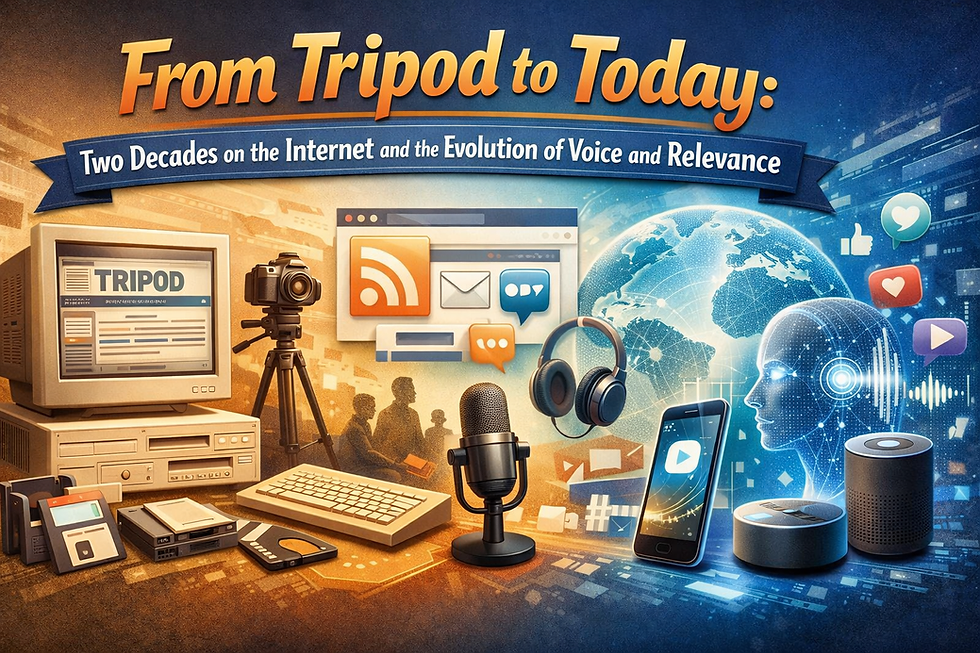
There is a certain quality to the early internet that is difficult to recreate today, not because the technology has changed, but because the mindset has. When I first began writing online, the act itself felt exploratory rather than expressive, almost as if the medium existed first and the purpose followed later. The platforms were basic, often unreliable, and aesthetically limited, yet they offered something that is increasingly rare now—an absence of expectation. You were not writing to build an audience, nor were you trying to establish authority. You were simply placing thoughts into a space that was open, unstructured, and largely indifferent to performance. In that indifference, there was a kind of freedom that shaped the earliest form of digital voice, one that was unfiltered not because it was bold, but because it was unaware.
As the internet evolved and platforms became more structured, the nature of writing began to change in subtle but important ways. The shift was not immediate, nor was it consciously acknowledged at the time, but it gradually introduced a sense of direction into what had previously been an open-ended exercise. Writing became more intentional. There was a growing awareness that what was being published could be read, revisited, and perhaps even remembered. This awareness did not necessarily impose pressure, but it did create a certain discipline. Thoughts were framed more carefully, sentences were constructed with greater attention, and over time, a sense of continuity began to emerge. One piece no longer stood entirely alone; it became part of a larger, evolving body of work. It is in this transition that voice begins to take form—not as something deliberately crafted, but as something revealed through repetition and reflection.
At some point along this journey, the idea of relevance inevitably enters the frame, often without invitation. It does not arrive as a clear question but as a subtle undercurrent shaped by observation. You begin to notice what others are writing, what gains attention, what is amplified, and what fades. There is a natural inclination to align with what appears current, to participate in conversations that are already in motion. Yet, this alignment comes with a quiet tension. Writing for relevance often requires responsiveness, speed, and a degree of conformity to prevailing narratives. While this can enhance visibility, it also introduces a certain impermanence. What is considered relevant today may lose significance tomorrow, not because it lacked value, but because the context shifted. In contrast, voice operates on a different axis. It is slower, less reactive, and often less visible in the short term, but it carries a continuity that extends beyond immediate engagement.
Consistency, in this context, becomes less about frequency and more about presence. There are phases when writing flows naturally and periods when it recedes into the background, often due to shifting priorities or professional commitments. These interruptions can create the impression of discontinuity, yet over time, it becomes clear that the act of returning holds more significance than uninterrupted output. The continuity of a personal platform is not defined by how often one writes, but by the sustained intention to write. Each return adds another layer, not just to the content, but to the underlying voice. In this sense, gaps do not break the narrative; they become part of it, contributing to a rhythm that is shaped as much by silence as by expression.
The role of the audience also undergoes a transformation across this timeline. In the early stages, the audience is largely invisible, almost hypothetical. Later, it becomes measurable through metrics that quantify reach and engagement. While such metrics can provide useful insights, they also have the potential to distort priorities if allowed to dominate the process. When writing becomes overly responsive to audience expectations, it risks losing its internal coherence. The focus shifts from articulation to reception, from clarity of thought to predictability of response. A personal platform, however, offers the possibility of maintaining a different balance. It allows writing to exist without immediate validation, to explore ideas that may not resonate widely but remain significant at an individual level. This does not negate the value of an audience, but it repositions it, ensuring that it informs rather than dictates.
Over an extended period, identity begins to emerge not through declaration, but through accumulation. There is no singular moment when one defines a digital identity. Instead, it becomes visible through patterns—recurring themes, consistent perspectives, and a tone that stabilizes almost imperceptibly. Looking back, these patterns often appear more coherent than they felt in the moment. What seemed like isolated reflections gradually reveal a continuity of thought. This retrospective clarity is one of the most compelling aspects of long-term writing. It transforms a collection of individual pieces into a narrative of intellectual and personal evolution, one that could not have been constructed deliberately at the outset.
The increasing sophistication of platforms introduces new dimensions to this process. Design, structure, and presentation become integral to how content is perceived and engaged with. A website is no longer merely a repository of writing; it becomes a curated space that reflects intent and identity. This shift necessitates decisions about organization, emphasis, and direction. While such structure enhances accessibility, it also carries the risk of limiting spontaneity. The challenge lies in maintaining a balance where the platform supports the writing without constraining it, where form enhances function without dictating it.
Maintaining multiple platforms further sharpens the distinction between different modes of writing. Some spaces demand precision, clarity, and analytical rigor, operating within defined thematic boundaries. Others allow for reflection, ambiguity, and exploration without the need for resolution. This distinction is not merely functional; it is philosophical. A professional platform serves a specific purpose, often aligned with expertise and structured argumentation. A personal platform, in contrast, provides space for thought without immediate conclusion, for observations that may remain open-ended. This form of writing, while less structured, is not necessarily less demanding. It requires a different kind of discipline, one that prioritizes honesty over completeness.
Periods of silence, often perceived as interruptions, gradually reveal themselves as integral to the process. Not writing does not equate to disengagement. It often signifies a phase of internal consolidation where ideas take shape without immediate expression. During such periods, the absence of output can create a sense of distance from the platform, yet it also allows for a depth of perspective that continuous production may not accommodate. When writing resumes, it often does so with greater clarity, informed by the reflections that occurred in silence. In this sense, silence is not a void but a form of preparation.
With the passage of time, the concept of relevance undergoes a subtle but significant transformation. It becomes less about alignment with current discourse and more about continuity of perspective. To remain relevant is not necessarily to remain visible at all times, but to maintain a voice that retains its coherence even as contexts change. This form of relevance is less immediate but more enduring. It does not depend on trends, nor does it require constant adaptation. Instead, it emerges from a sustained engagement with ideas that retain their significance beyond specific moments.
Across this entire journey, certain elements remain unchanged. The curiosity that initiated the process continues to drive it. The need to articulate, to examine, and to understand persists regardless of the platform or format. While the external environment evolves—introducing new tools, new expectations, and new forms of engagement—the internal impulse remains consistent. Recognizing this continuity provides a sense of stability, allowing the focus to remain on the act of writing itself rather than the conditions surrounding it.
In an environment increasingly defined by speed, visibility, and constant output, the value of a personal platform becomes more pronounced. It offers a space that is not entirely governed by external metrics, where writing can exist without immediate purpose or validation. Such a space does not compete with other platforms; it complements them by accommodating forms of expression that may not fit within structured or professional frameworks. It allows for a continuity of voice that is not disrupted by shifts in format or audience expectations.
Looking ahead, it is evident that the internet will continue to evolve, introducing new platforms, new modes of engagement, and new definitions of relevance. Yet, the fundamental questions remain unchanged. What does it mean to write in a space that is constantly shifting? What does it mean to maintain a voice in an environment that rewards immediacy? These questions do not have fixed answers, nor do they require definitive resolution. Their value lies in the process of engagement, in the ongoing effort to navigate a landscape that is both dynamic and enduring.
If there is a single thread that connects the journey from the early days of simple web pages to the present, it is the continuity of voice. Platforms change, formats evolve, and audiences fluctuate, but the underlying impulse to articulate remains constant. Voice is not something that is established at a particular moment; it is something that develops over time, shaped by repetition, reflection, and persistence. It is sustained not by visibility alone, but by the willingness to continue, even when the context changes and the pace shifts.
From the simplicity of early platforms to the complexity of the present, the journey is not defined by technological milestones but by the gradual formation of perspective. It is a process that resists acceleration, one that unfolds over years rather than moments. In that sense, relevance is not something that is achieved once and maintained indefinitely. It is something that is continually redefined through engagement, through consistency, and through the quiet discipline of returning to the act of writing itself.


Comments