top of page

10:48
India’s Next Aircraft Carrier: Another Vikrant or a CATOBAR Future?
India is preparing for the next generation of aircraft carriers. But should the country simply build another carrier based on the INS Vikrant design, or should India finally return to CATOBAR carrier aviation?
India has actually operated catapult-equipped aircraft carriers before.
The original INS Vikrant operated Sea Hawk fighter aircraft using a steam catapult. Later, India transitioned to the Sea Harrier, a STOVL aircraft that did not require catapult-assisted takeoff. INS Viraat consequently continued with the STOVL approach.
Today, India has returned to conventional carrier aviation with INS Vikramaditya and INS Vikrant, both using STOBAR operations.
But the future may demand something different.
A CATOBAR carrier could allow India to operate aircraft with greater launch weights, more fuel and heavier weapons. More importantly, it opens the door to a new generation of carrier aviation—including fixed-wing airborne early warning aircraft, heavier unmanned systems, UCAVs and future carrier-based fighters.
So the real question is not simply:
Should India build another aircraft carrier?
It is:
Should India's next major carrier be designed around today's aircraft—or tomorrow's?
In this episode of Manoj Ambat World View, we examine India's carrier evolution from INS Vikrant and Sea Hawk, through Sea Harrier and INS Viraat, to INS Vikramaditya and INS Vikrant, and ask what India's future carrier fleet should look like.
In this video:
- India's first CATOBAR carrier experience
- INS Vikrant and Sea Hawk operations
- Why India moved from CATOBAR to STOVL
- INS Viraat and the Sea Harrier era
- STOBAR and the modern INS Vikrant
- Why CATOBAR matters for aircraft payload
- Full-payload carrier aircraft operations
- Future carrier-based fighters
- Fixed-wing AEW aircraft and carrier aviation
- UCAVs and unmanned carrier operations
- India's future aircraft-carrier strategy
- Why the next carrier should be designed for the 2040s
The question is no longer whether India can build another Vikrant. The question is whether the carrier after Vikrant should still be a Vikrant.
Subscribe to Manoj Ambat World View for independent analysis of India's strategic affairs, defence technology, geopolitics and the future of warfare.
#India #IndianNavy #AircraftCarrier #INSVikrant #INSViraat #INSVikramaditya #CATOBAR #STOBAR #SeaHawk #SeaHarrier #AircraftCarriers #IndianDefence #NavalPower #CarrierAviation #IndianNavy #DefenceTechnology #MaritimeStrategy #NavalStrategy #TEDBF #EMALS #FutureWarfare #ManojAmbatWorldView #IndiaDefence #Geopolitics #MilitaryTechnology

10:01
Who Holds The Real Power in India? You Need To Know This
In a democracy, an elected government can and should be challenged. Opposition, protest and criticism are essential to a healthy democratic system. But if a political party wants to replace an elected government, should it not ultimately have to convince the people of India?
In this Manoj Ambat Worldview, I examine the idea of the democratic mandate in India, the role of political opposition, parliamentary disruption, electoral accountability and the responsibility of political parties to present a credible alternative vision of governance.
If you believe the BJP has failed, explain why. If you believe another political formation can govern India better, explain how. Present the programme, convince the electorate, contest the election and win the mandate.
This is not an argument for the BJP. It is an argument for a principle that should apply equally to every political party: governments are ultimately replaced by the people through the democratic process.
The question we should ask is not merely, “How do we remove them?” but “What do we offer India instead?”
#ManojAmbatWorldview, #IndianDemocracy, #DemocraticMandate, #IndianPolitics, #BJP, #PoliticalOpposition, #ElectionsIndia, #Democracy, #ElectoralMandate, #Parliament, #PoliticalAccountability, #Governance, #India, #OppositionPolitics, #DemocraticValues
09:13
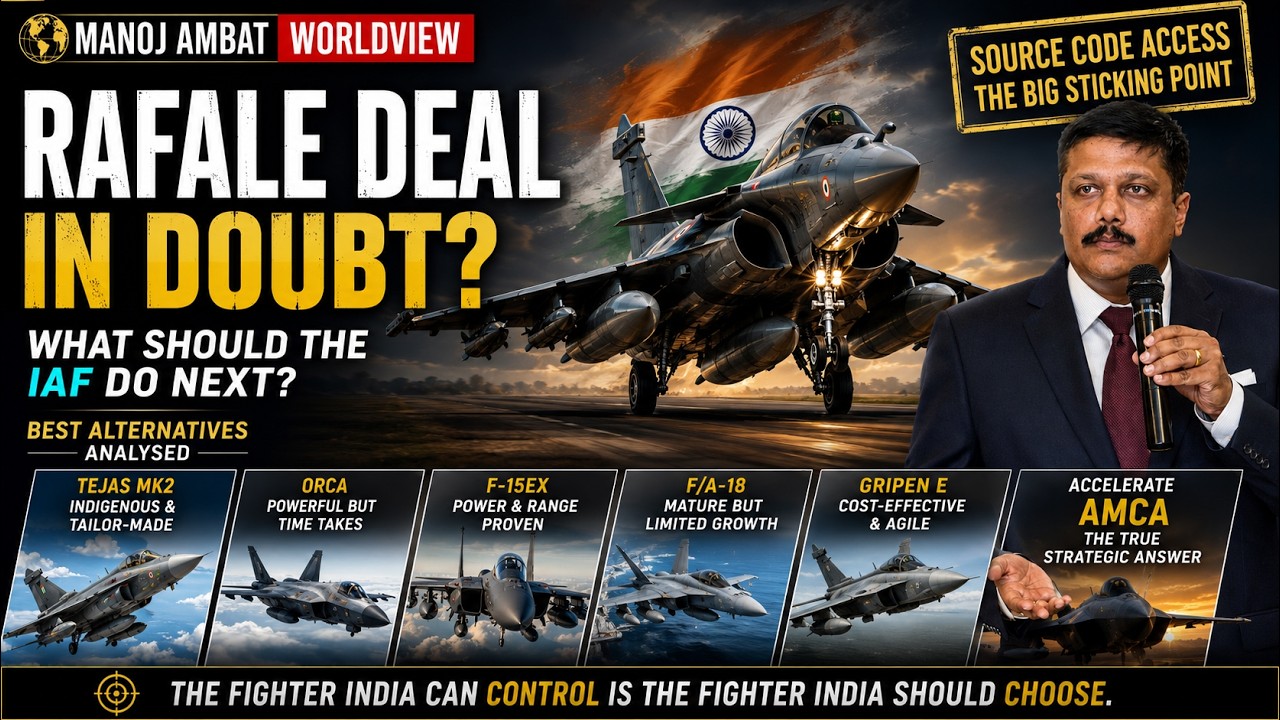
Rafale Deal in Doubt? The Best Alternatives for the Indian Air Force
Is India's proposed procurement of additional Rafale fighter jets facing a strategic roadblock? One of the key issues is India's desire to integrate indigenous weapons such as the Astra Beyond Visual Range Air-to-Air Missile (BVRAAM) and connect the aircraft seamlessly with the Integrated Air Command and Control System (IACCS). Reports suggest that France remains reluctant to provide access to the Rafale's mission system source code, raising important questions about long-term operational sovereignty.
In this episode of Manoj Ambat Worldview, Advocate Manoj Ambat analyses whether India should continue pursuing the Rafale deal or look at alternative options. The discussion compares the indigenous Tejas Mk2, the proposed ORCA fighter, the fifth-generation AMCA, and foreign alternatives such as the F-15EX, F/A-18 Super Hornet, and Gripen E.
The episode examines technology transfer, software sovereignty, indigenous weapons integration, network-centric warfare, and the future direction of the Indian Air Force's fighter fleet.
If the Rafale negotiations fail, what is the best path forward for the IAF? Watch this strategic analysis to understand the options and their implications for India's air power.
Read the complete analysis- https://www.manojambat.in/post/rafale-source-code-dispute-best-alternatives-indian-air-force
Rafale, Indian Air Force, IAF, Rafale Deal, Dassault Rafale, Tejas Mk2, Tejas Mark 2, AMCA, ORCA Fighter, TEDBF, Astra Missile, Astra BVRAAM, IACCS, Indian Defence, Defence Analysis, Military Aviation, Fighter Jets, Air Power, India Defence, Make in India Defence, Indigenous Defence, Defence Technology, Strategic Affairs, Geopolitics, Military Strategy, Air Combat, Network Centric Warfare, Software Sovereignty, Defence Procurement, Manoj Ambat Worldview

05:10
Pakistan's New Hangor-Class Submarines: A Real Threat or a Strategic Illusion?
Pakistan has begun inducting the Chinese-built Hangor-class submarines, a new generation of air-independent propulsion (AIP) diesel-electric attack submarines derived from China's Type 039A/039B design. These submarines significantly enhance Pakistan's underwater endurance and operational reach, potentially enabling deployments far beyond the Arabian Sea and even into the Bay of Bengal.
But does longer range automatically translate into strategic advantage?
In this episode of Manoj Ambat Worldview, I examine whether the Hangor-class submarines truly alter the naval balance in the Indian Ocean or whether operational realities limit their effectiveness. We explore Pakistan's expanding submarine capability, China's growing influence in the region, India's layered anti-submarine warfare (ASW) network, the logistical challenges of operating far from home ports, and why endurance alone is not enough to dominate the seas.
This episode provides a balanced strategic assessment of one of South Asia's most important naval developments.
Topics Covered:
Pakistan Navy Hangor-class submarines
Chinese Type 039A/039B submarine design
Air Independent Propulsion (AIP)
Bay of Bengal strategic competition
Indian Navy anti-submarine warfare
P-8I maritime patrol aircraft
Indian Ocean naval balance
India-Pakistan maritime rivalry
Chinese naval technology
Strategic implications for regional security
Pakistan Navy, Hangor Class, PNS Hangor, Type 039A, Type 039B, Chinese Submarine, AIP Submarine, Diesel Electric Submarine, Indian Navy, Bay of Bengal, Indian Ocean, Anti Submarine Warfare, P8I Neptune, Maritime Security, Naval Strategy, India Pakistan, China Pakistan, Indo Pacific, Military Analysis, Defence Analysis, Strategic Affairs, Geopolitics, Manoj Ambat Worldview
bottom of page